ACM IMWUT/UBICOMP 2025
Publication
XRF V2: A Dataset for Action Summarization with Wi-Fi Signals, and IMUs in Phones, Watches, Earbuds, and Glasses
Bo Lan, Pei Li, Jiaxi Yin, Yunpeng Song, Ge Wang, Han Ding, Jinsong Han, Fei Wang
XRF V2 is a multimodal indoor action dataset for temporal action localization and action summarization, combining Wi-Fi CSI, IMUs from phones, watches, earbuds, and glasses, and synchronized RGB-D-IR video across realistic smart-home scenes.
Multimodal Action Sensing
XJTU, XDU, ZJU
Overview
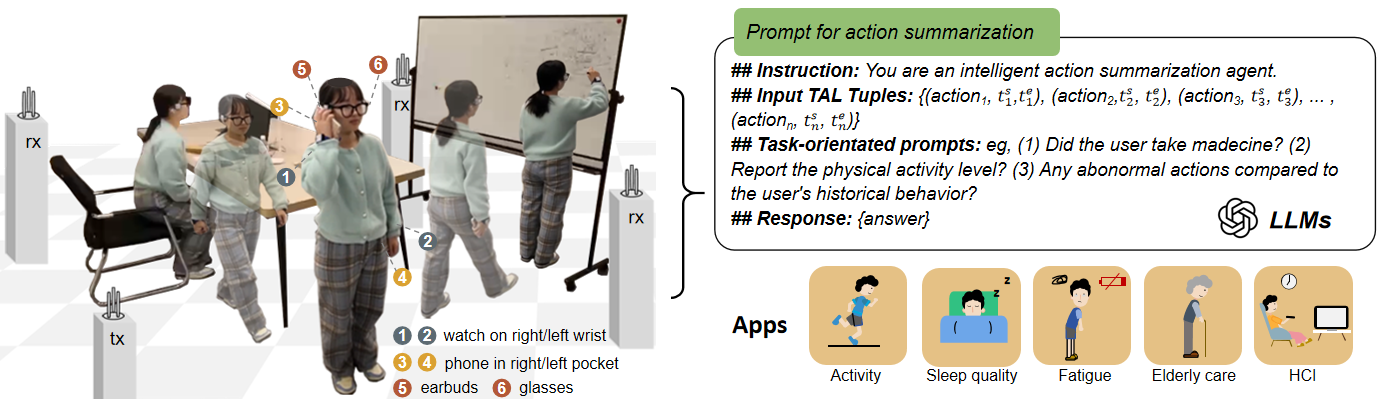
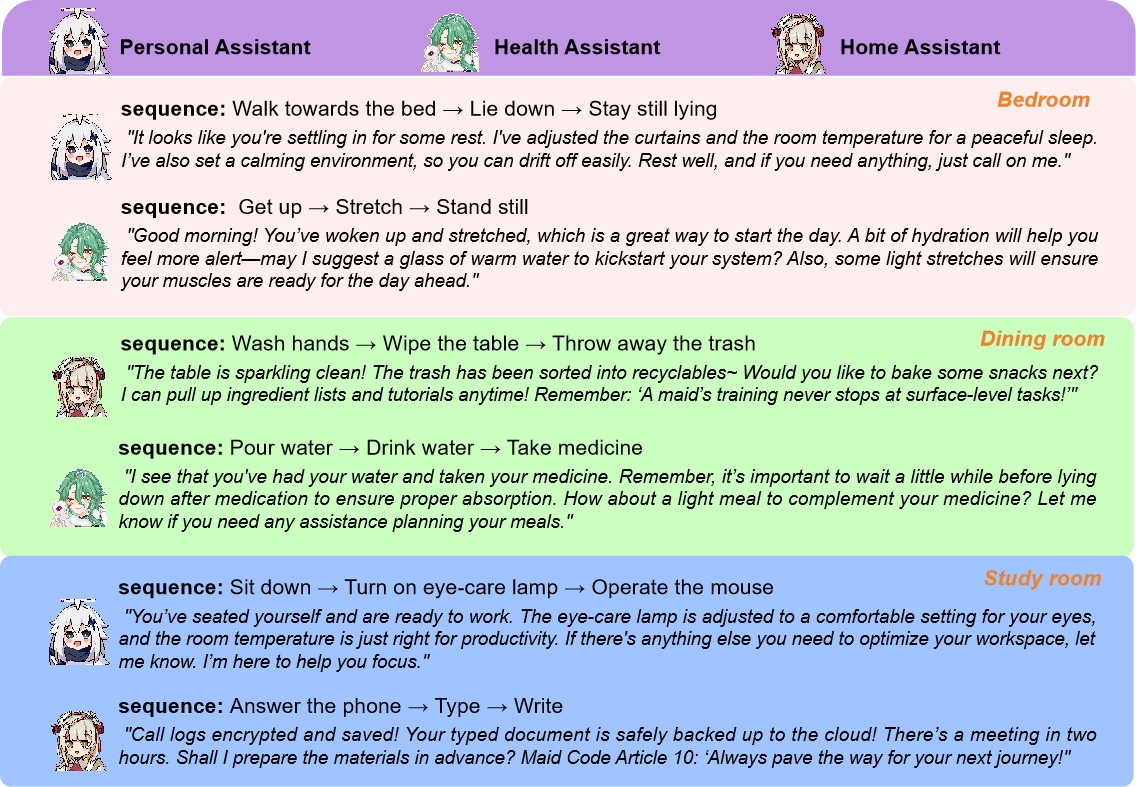
Human action recognition usually assigns a label to a short, isolated action. XRF V2 moves toward a richer smart-home setting: a person performs continuous daily routines, the system localizes each action with start and end times, and those action tuples can be passed to an LLM agent to summarize behavior, answer task-oriented questions, or support home and health assistants.
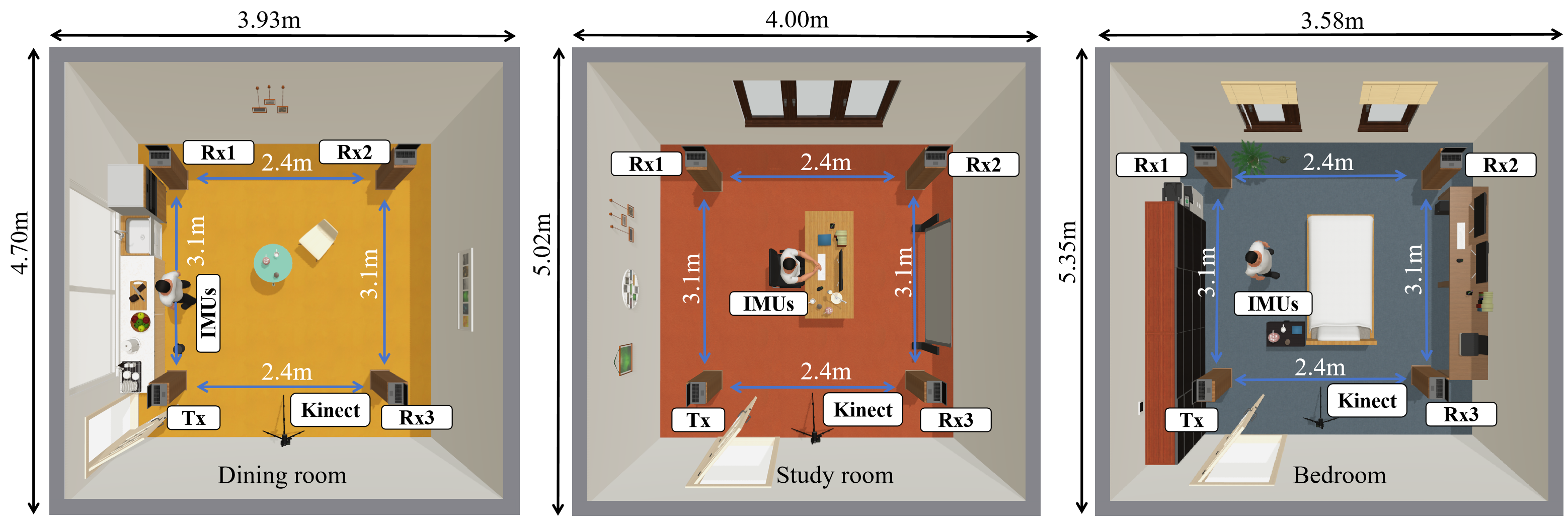
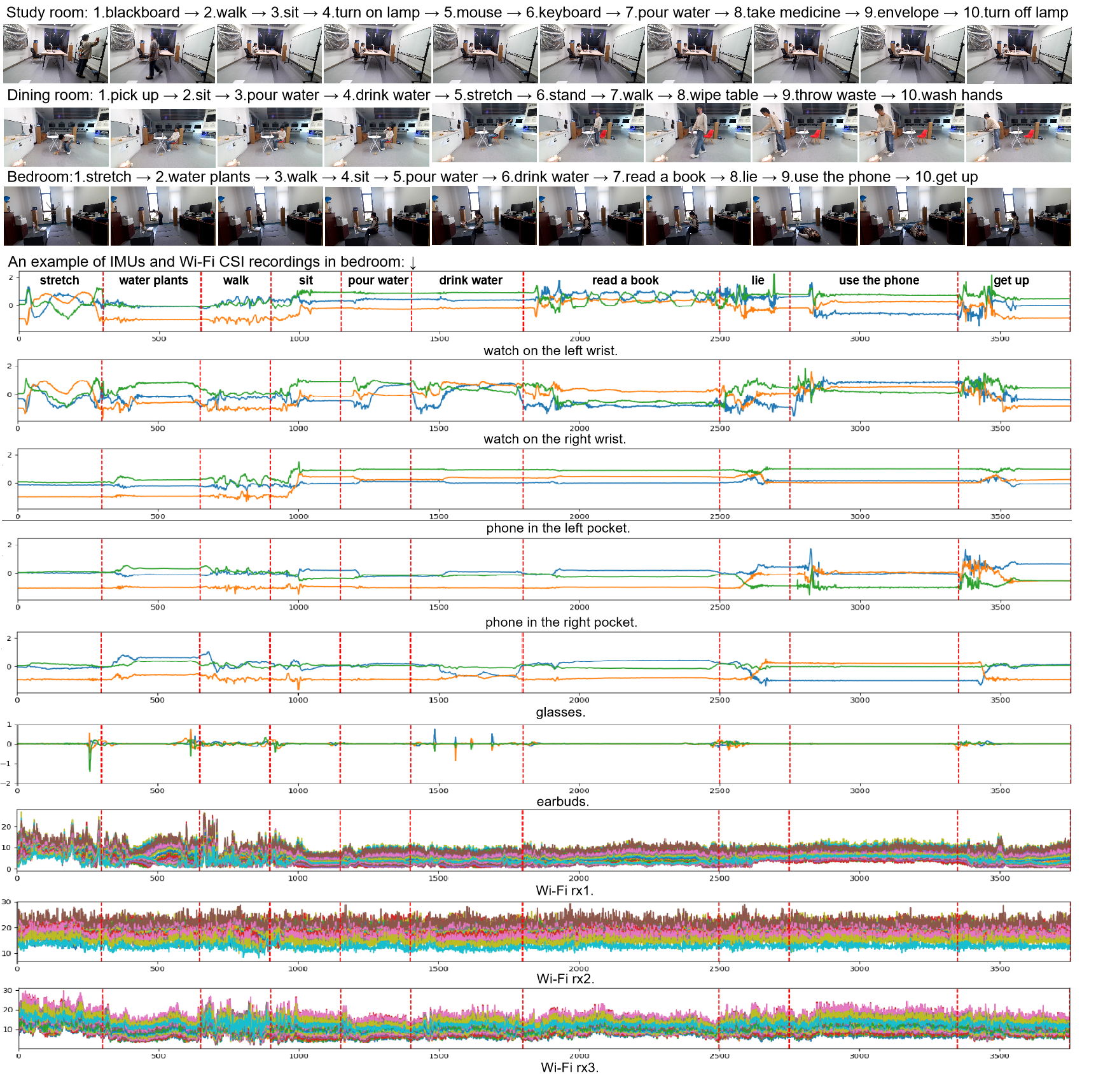
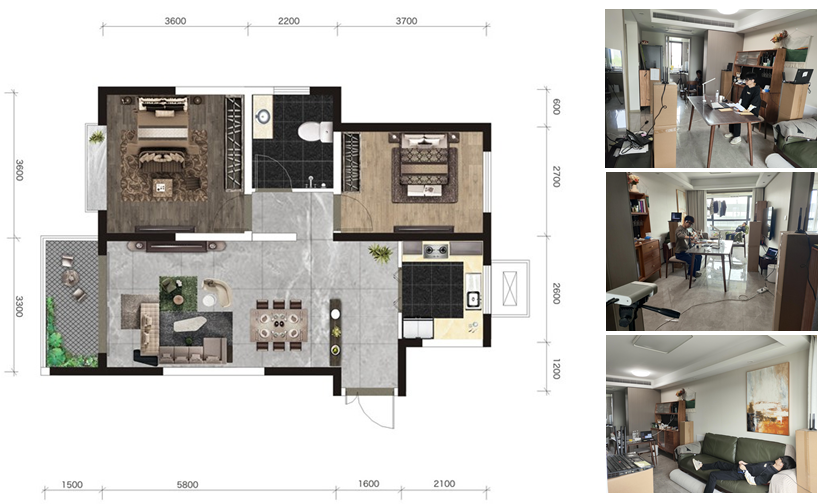
The dataset integrates Wi-Fi CSI, IMU streams from consumer devices, and synchronized RGB-D-IR video. It was collected from 16 volunteers across three indoor environments: dining room, study room, and bedroom. After filtering incomplete recordings, XRF V2 contains 853 valid multimodal sequences and 16 h 16 min 8 s of data.
The institution field is abbreviated at the university level: XJTU, XDU, and ZJU.
Why This Dataset Matters
Existing temporal action localization datasets are often video-centric, task-specific, or focused on outdoor and sports scenarios. Indoor daily routines raise different requirements: privacy, continuous activity, diverse consumer devices, and robustness when some sensors are unavailable or poorly worn.
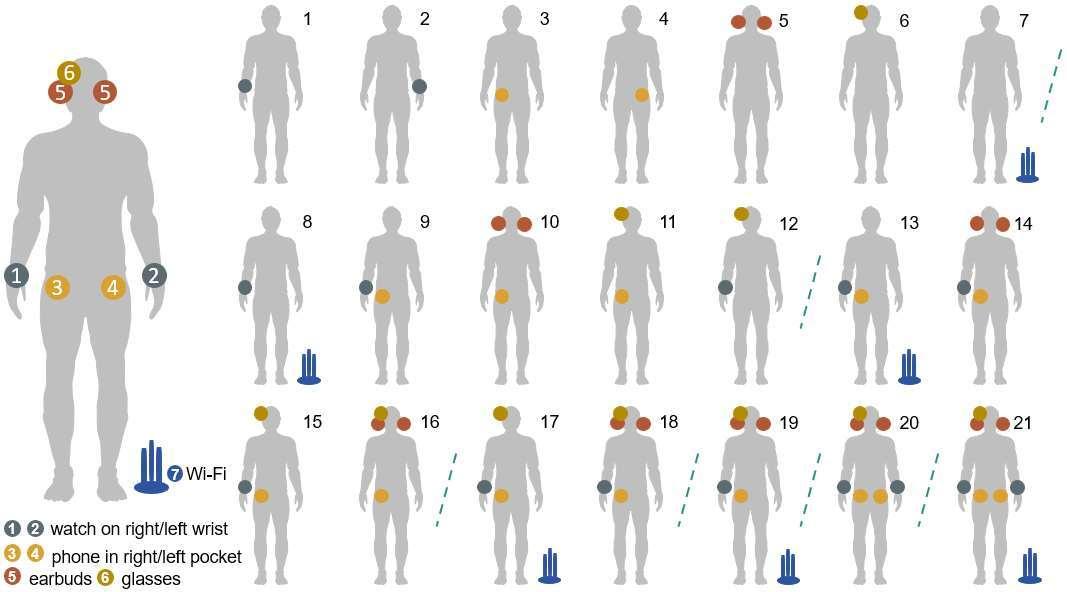
XRF V2 is designed for that setting. It includes common home devices and ambient Wi-Fi, so researchers can test not only a full multimodal system, but also practical combinations such as a single watch, phone + watch, or Wi-Fi + wearables. This makes the dataset useful for smart homes, elderly care, personal assistants, health monitoring, multimodal learning, pose estimation, and synthetic sensor data generation.
Dataset Details
| Item | XRF V2 |
|---|---|
| Scenes | Dining room, study room, bedroom |
| Actions | 30 indoor daily actions |
| Volunteers | 16 |
| Valid sequences | 853 |
| Total duration | 16 h 16 min 8 s |
| Train / test split | 682 / 171 sequences |
| Modalities | Wi-Fi CSI, 5 IMU device groups, RGB-D-IR video |
| Device sources | 2 smartphones, 2 smartwatches, earbuds, smart glasses, Wi-Fi transceivers, Kinect |
The paper reports an 80:20 stratified split across environments and participants. Dining room contributes 305 valid sequences, study room 320, and bedroom 228, giving a balanced benchmark for temporal action localization and downstream action summarization.
XRFMamba
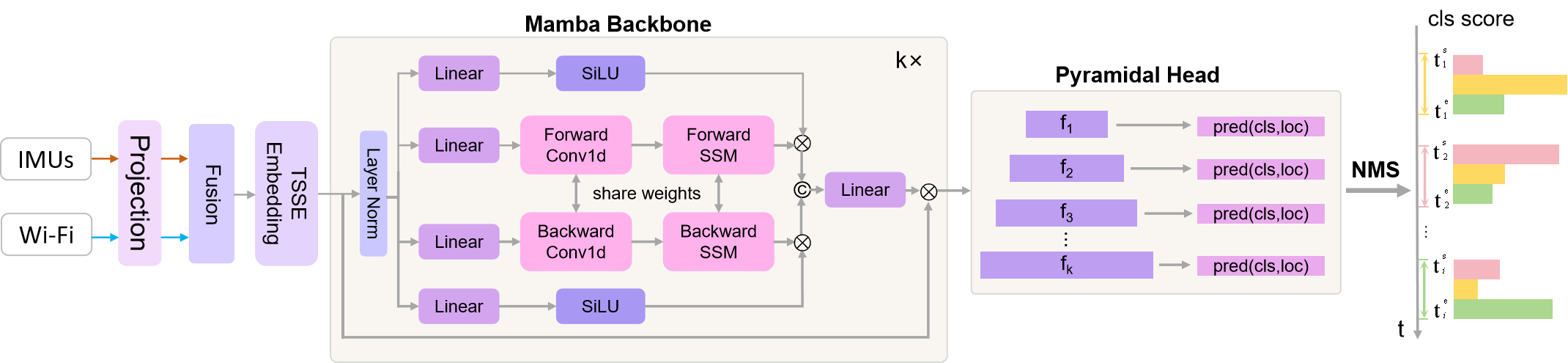
To benchmark the dataset, the paper proposes XRFMamba, a temporal action localization model built around state space modeling. The network first projects Wi-Fi and IMU streams into aligned feature channels, fuses the modalities, embeds temporal signals with a TSSE-style module, and uses a Decomposed Bidirectional Mamba backbone to model long-range dependencies. A pyramidal prediction head then outputs both action classes and temporal boundaries.
This design targets the central difficulty of action summarization: the model must understand long, untrimmed sensory sequences containing multiple actions, not just classify short clipped examples.
Evaluation Highlights
| Result | Value |
|---|---|
| Average mAP for temporal action localization | 78.74 |
| Improvement over WiFiTAD on mAP@avg | +5.49 points |
| Parameter reduction vs. WiFiTAD | 35% fewer parameters |
| mRMC for action summarization | 0.802 |
| Leave-one-person-out mAP | 72.84 |
| Single right-hand smartwatch mAP | 65.81 |
| Real-apartment zero-shot mAP | Around 70 |
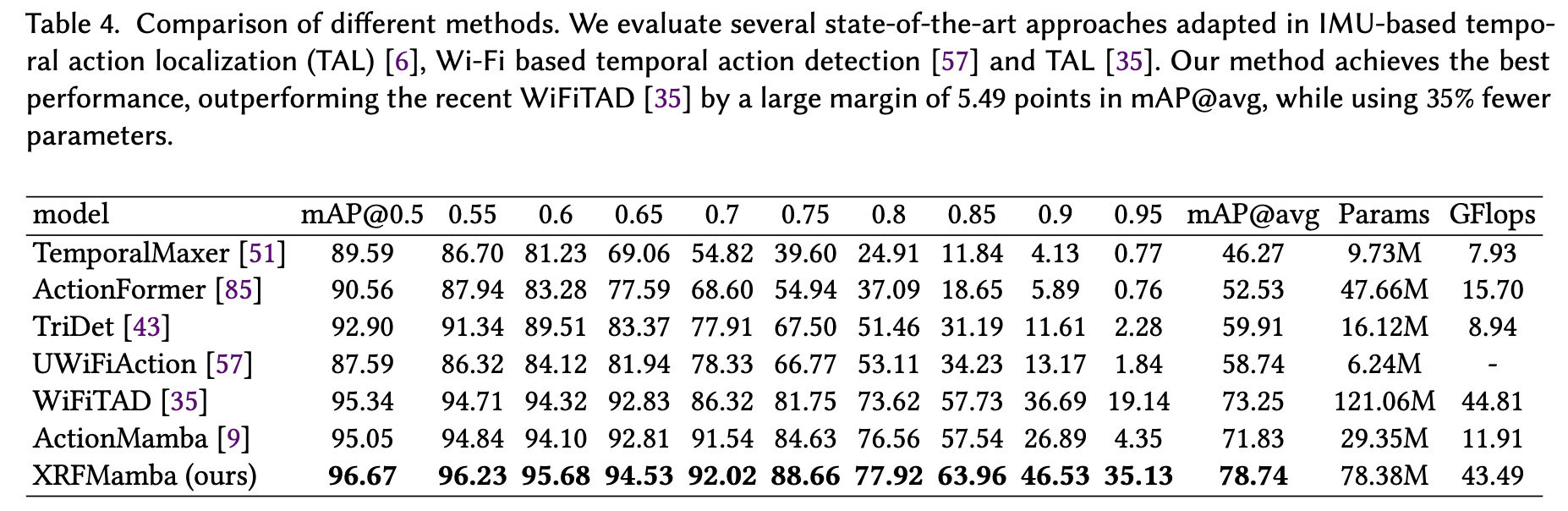
XRFMamba outperforms adapted temporal action localization baselines including TemporalMaxer, ActionFormer, TriDet, UWiFiAction, WiFiTAD, and ActionMamba. The paper also introduces Response Meaning Consistency (RMC), a human-audited metric that checks whether LLM responses based on predicted action tuples preserve the meaning of responses based on ground truth tuples.
Device Flexibility
A useful part of XRF V2 is that it supports many sensor combinations. The paper studies individual devices and combinations of phones, watches, earbuds, glasses, and ambient Wi-Fi. Performance improves as more devices are available, but even sparse configurations remain meaningful. This matters in real homes, where a phone may be left on a table, a watch may be worn on only one wrist, or a Wi-Fi router may be temporarily unreliable.
Resources
- Code and dataset: https://github.com/aiotgroup/XRFV2
- Paper DOI: 10.1145/3749521
- Repository notes from the paper: model implementations are under
/model, XRFMamba is inmodel/TAD_multi_fusion.py, data loaders are under/dataset, paths are configured inbasic_config.json, training usesscript/train_run.py, and evaluation usesscript/test_run.py.
Citation
@article{lan2025xrfv2,
  title = {XRF V2: A Dataset for Action Summarization with Wi-Fi Signals, and IMUs in Phones, Watches, Earbuds, and Glasses},
  author = {Lan, Bo and Li, Pei and Yin, Jiaxi and Song, Yunpeng and Wang, Ge and Ding, Han and Han, Jinsong and Wang, Fei},
  journal = {Proceedings of the ACM on Interactive, Mobile, Wearable and Ubiquitous Technologies},
  volume = {9},
  number = {3},
  article = {98},
  year = {2025},
  doi = {10.1145/3749521}
}